
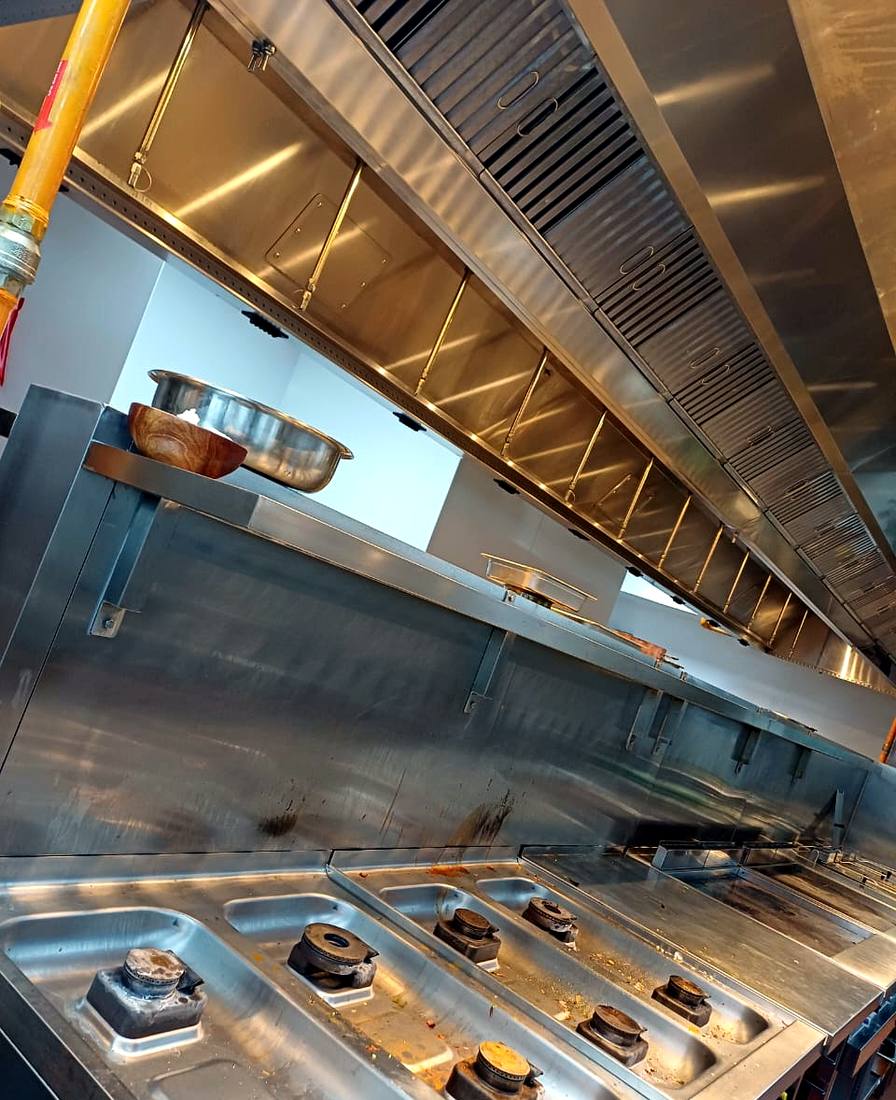
Most of the hood problems we get called in to fix were baked in on day one. The hood was too short for the range, it was hung too high, or nobody thought about how the staff would clean the filters. None of these are hard to get right. They just need a bit of thought before the order is placed.
Here is what we look at on site before we recommend a hood, and what we think every restaurant owner should ask their installer.
1. Start with what you cook, not the size of the room
A South Indian kitchen running dosa tawas all day has very different needs from a bakery or a tandoor-heavy North Indian kitchen. Tandoors and woks throw off intense heat. Deep fryers and tawas produce a lot of grease. Steamers and braising pans mostly create moisture.
Tell your installer exactly what equipment sits under the hood and how hard it runs at peak time. That one conversation decides the airflow, the filter type and the fan size more than anything else.
2. The hood should be bigger than the cooking line
Smoke and steam do not rise in a neat column. They spread. As a rule, a wall-mounted canopy should overhang the cooking equipment by around 150 mm on the front and each open side. If the hood stops exactly where the range stops, you will see smoke curling out at the edges every lunch rush.
Mounting height matters too. Too high and the hood loses its grip on the rising air. Too low and your cooks will be knocking their heads on it. Somewhere around 2 metres from the floor to the bottom edge of the hood works for most kitchens, but we always check against the actual equipment.
3. Wall canopy, island canopy or something decorative?
- Wall-mounted canopy: the most common choice. The wall behind helps guide the air into the hood, so it is efficient and simple to install.
- Island canopy: used when the cooking line is in the middle of the kitchen. It is open on all four sides, so it needs a larger overhang and more airflow.
- Decorative or show-kitchen hoods: for live counters and open kitchens where guests can see the cooking. These need the same performance as a back-of-house hood, just with a finish that suits the interior.
4. Pay attention to the filters
For most Indian commercial kitchens we recommend stainless steel baffle filters. They catch grease well, they handle high heat, and they can be lifted out and washed in a sink. Mesh filters are cheaper but clog quickly in heavy-frying kitchens and are a fire risk if they are not cleaned often.
Ask how the filters come out. If a staff member needs a ladder and a screwdriver, they will not be cleaned as often as they should be.
5. Material and build quality
Look for food-grade stainless steel (SS 304 is the usual choice) with welded or properly sealed joints. A hood with leaky seams will drip grease down onto the cooking area and the wall. Check that there is a grease collection channel and a drain cup that can be emptied.
6. The hood is only one part of the system
A well-made hood connected to the wrong fan or a badly routed duct will still perform poorly. The hood, duct, fan and electrical controls need to be planned together. This is why we prefer to handle the full job, from fabrication to commissioning, so one team is responsible for the end result.
Quick checklist before you sign off on a hood: Does it overhang the equipment on all open sides? Are the filters easy to remove? Is the steel food-grade with sealed joints? Has someone worked out the airflow for your actual equipment? Who is responsible for testing the system once it is installed?
If you are planning a new kitchen or replacing an old hood, send us your layout and a list of your equipment. We are happy to talk it through before you commit to anything.
More from the blog